Station Cottage
The GodmotherStation Cottage, Robbie Dexter’s home, is a rural dwelling whose cramped rooms and working farm surroundings shape Rachel Elliot’s reunion with him. It is at once a practical, untidy place and a storehouse of memory: Rachel arrives expecting a house she has seen on television, but encounters the imperfect reality of Robbie’s life there, and the two gradually make the cottage a setting for renewed closeness.
Setting and approach
The cottage lies beyond narrow country lanes reached after Rachel leaves the motorway. Robbie’s directions lead her past the Fox and Hounds and towards a hand-painted Station Cottage sign, half-buried in brambles. The sign’s arrow points upwards beneath a mass of grey cloud, while tractor wheels have cut deep gullies into the mud on the final stretch. These details make the journey a passage from the familiar public image of Robbie to the less polished place where he actually lives.
Rachel has seen Robbie on television, and the cottage initially carries the unreality of a film set: she feels as if she is arriving to perform a role without a script. Yet the house does not match the image she has brought with her. Its bricks appear less red and spruce than they did on screen, and Robbie’s white van is splashed with mud. The contrast places the reunion between representation and lived experience. Rachel must meet not a glamorous image, but Robbie in his own surroundings, where the ordinary condition of the house is impossible to edit away.
Rooms and domestic life
The interior introduces Robbie through the work he has been doing to prepare for Rachel’s visit. He is putting away a vacuum cleaner suspended from a brass hook above the cellar steps. The hook gives way under its weight, sending the cleaner down the steps and knocking over buckets, aerosol cans, and a broom. Robbie does not retrieve it; he has finished using it. The small domestic mishap establishes the cottage as functional but disorderly, and makes his effort to ready the house visible without turning it into a polished display.
His preparations extend to the rooms Rachel enters. After she arrives, Robbie is still adjusting a faded print of an English beach that has been knocked crooked when he trips on a loose flagstone. He has pushed the contents of the spare room into the attic, where the accumulated debris of his life remains in untended heaps. Rachel, meanwhile, looks around the kitchen at its pictures and cupboards, her heels clicking over cracked tiles between rugs and carpets. She calls the cottage lovely, but her manner is initially careful and formal; familiar surroundings do not immediately remove the strangeness of seeing Robbie again.
The kitchen also becomes a practical space for overcoming that awkwardness. Robbie searches a wooden chest for clothing and footwear when Rachel needs suitable boots. The pair she chooses belonged to Polly Drayton, who left them behind after Robbie gave her a new, fur-lined pair. Thus an everyday object brings another relationship into the room even as Rachel and Robbie begin to reconnect. The cottage’s possessions are not neutral furnishings: they carry the marks of lives that preceded Rachel’s visit.
Farmyard and shared time
Outside, the cottage opens onto outhouses used for storing food and equipment, hutches, chickens, a ditch, and fields where Robbie keeps sheep. A bridge over the ditch has been washed away by the previous winter’s heavy rain, and Robbie says replacing it remains on his to-do list. Rachel leaps across rather than treating the missing bridge as an obstacle, and steadies herself with a hand on his arm when she lands. Their brief physical contact is reassuring to both after the uncertainty of their first meeting.
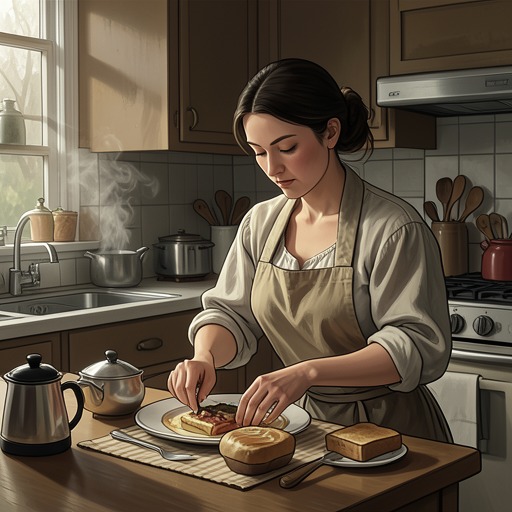
The farm also interrupts the reunion with work that cannot be made picturesque. Robbie describes a spell of foot rot among the sheep after a warm, wet period before Christmas and says he will need to use the clippers again. Rachel’s borrowed boots have cracked soles and are letting in the cold and damp. Seeing her discomfort, Robbie stops tending to the sheep and suggests they go inside for tea, a fire, toast and jam, and a simple supper of baked potatoes and cold meat. His decision to let the animals wait makes care for Rachel momentarily more pressing than the farm’s demands, while the modest meal reflects the limits of his domestic skill.
The house then holds a quieter form of shared time. Tea is accompanied by old photographs, prompting laughter at their younger appearances and memories of friends whose names they can no longer recall. As they look through the album, amusement gives way to more difficult recollections: Rachel considers the past and the dreams, including parenthood, that had separated them. On the ragged brown leather sofa, the distance between them narrows gradually, until Rachel’s stockinged feet reach Robbie and he holds them in his hand. The cottage’s ordinary furnishings provide the setting for a change in the reunion from tentative conversation to renewed physical trust.
Memory, intimacy, and separation
The significance of Station Cottage is not confined to the first visit. In the days Rachel spends there, its rooms and routines provide a temporary shelter for a relationship still shadowed by unresolved questions. On their last evening, she and Robbie sit on opposite sides of the fire with their feet towards the hearth and their free hands joined across the space between them. Their imminent departures press upon the scene: Rachel must return to a party and a life whose attractions are fading, while Robbie faces unanswered messages, bills, estimates, and forty-two pregnant sheep. The cottage holds them together for the moment, but the practical lives waiting outside it make their separation unavoidable.
The location also becomes a place of painful absence for Polly. Much later, after a Christmas gathering, she comes out into the night because Robbie has not appeared and she wants to see that his black car is gone. Finding no car, she approaches his cottage and writes on the frost-covered window of his van before forcing frozen sheep droppings through the front-door letter flap and running off. Nearby, the sheep have been moved from the field into a barn, where straw and feed await them. These details return the cottage to the rural working world around it, while Polly’s actions expose the hurt and desperation that coexist with Rachel and Robbie’s renewed intimacy. Station Cottage is therefore both a home in which affection can recover its footing and a fixed point around which attachment, jealousy, and loneliness continue to gather.